
Shelby County Previous Resident Sources
Start with the source closest to the date being studied. A current Shelby County parcel leads into the deed chain. Recent past residents may appear in a short verified directory run or a permit. Earlier household work relies more on public census schedules, school censuses, newspapers, probate, funeral records, and town-specific Sanborn maps. The ranges below are verified holdings, not a promise that every year or address is complete.
| Source | Verified years | Where held | What it can show |
|---|---|---|---|
| ROAM deeds | 1819 to present online | Probate Recording | Parties, transfer date, instrument, legal description |
| Federal census | Public through 1950 | ADAH, HeritageQuest, NARA | Household and nearby households |
| School census | 1912, 1916, 1920, 1924 | Museum & Archives | Guardian, child, age, and some address details |
| County directories | 2000, 2001, 2002 | ADAH | Entries subject to volume inspection |
| Newspapers | 1866 to current holdings | Museum & Archives | Deaths, moves, marriages, and property events |
| Sanborn maps | 1889 to 1933 by town | Library of Congress | Street and structure continuity, not occupants |
Dates determine the best route. A twentieth-century household may be visible in a census or school census even when no directory survives. An early deed can name an owner without naming the household. Treat the source type as part of each finding.
Trace Shelby County Resident Owners
A deed chain begins with land, not a remembered surname. Resolve the street address through the Shelby County GIS viewer. Save the parcel number, current owner link, subdivision, lot and block, map book and page, and deed instrument. Those identifiers can survive a change in house number, route, or postal city.
- Open the present parcel and record its legal description and current deed citation.
- Find that instrument in ROAM and transcribe the grantor, grantee, date, book and page, and land description.
- Search the seller as an earlier grantee. Confirm that the legal parcel, not just the name, matches.
- Repeat the process. Check executor, estate, quitclaim, foreclosure, tax, redemption, or sheriff instruments when a simple sale is absent.
- If an image or mortgage cancellation is missing, use the Probate Recording room, phone, or mail route.
- Grantor and grantee
- The grantor transfers an interest; the grantee receives it.
- Chain of title
- The linked sequence of recorded transfers for the same land.
- Legal description
- The lot, block, subdivision, or metes-and-bounds wording that identifies land apart from its street label.
Ownership is not residence. An heir may receive land without moving into it, and a trustee or business may hold title. Label each deed party by role before adding that name to the address timeline.
Shelby County Resident Deed Records
ROAM Public Access is the remote starting point for Shelby County land records. Search fields include instrument number, recording-date range, last or company name, first name, document type, book and page, map book and page, lot and block, section-township-range components, and a legacy number. Name modes include starts with, contains, exact, and phonetic, which is useful for old spelling and indexing shifts.
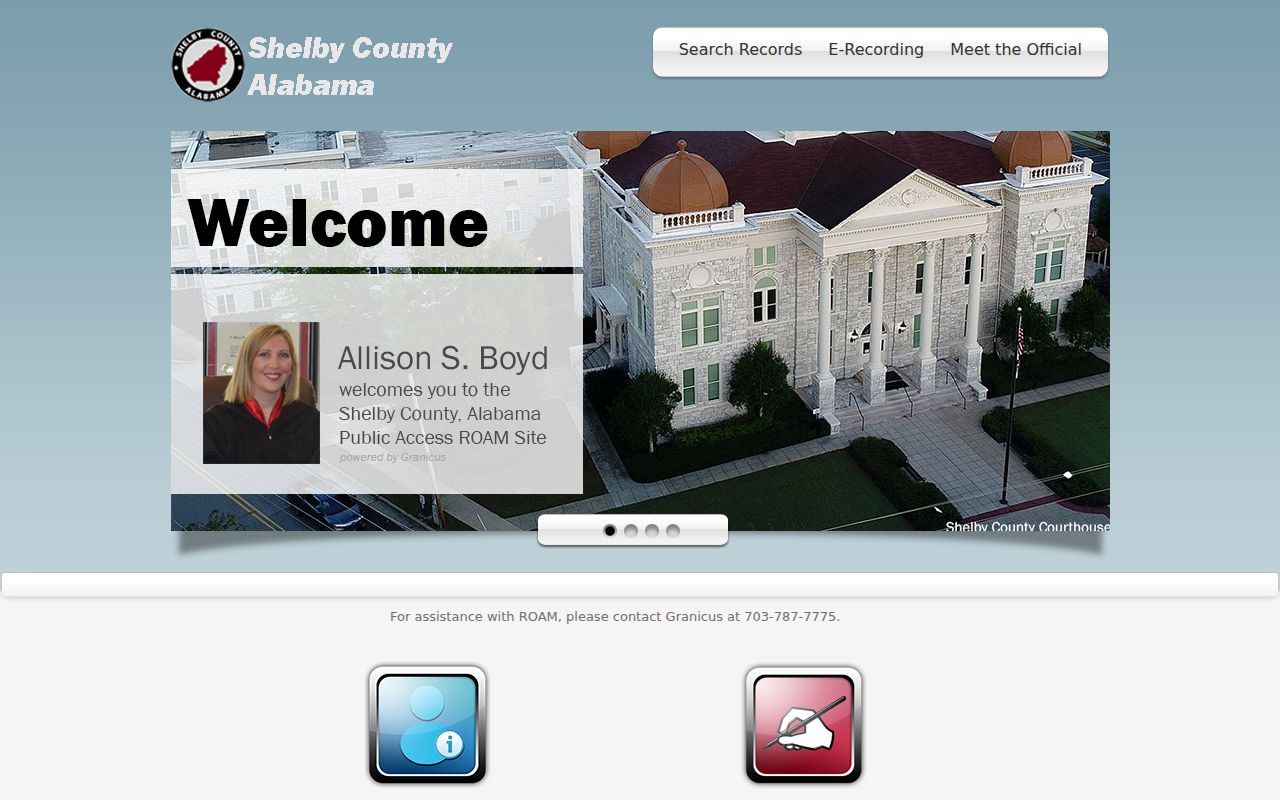
The official gateway appears in the captured image below. It is the right online doorway for a deed-led address search, while the detailed index supplies the party and legal fields needed to move backward.
ROAM results can show instrument number, recording date and time, indexed party and role, document type, opposite party, book and page, map reference, legal description, and an image link. Search is free through the index, but the research did not verify an image price or account rule.
Shelby County Records Still Use Books
Shelby County states that deeds from 1819 to the present are online, an unusually deep span. The same county guidance warns that some old mortgage cancellations have no electronic image. That gap can break a chain even when the deed index looks complete. Probate Recording's room at 112 N. Main Street in Columbiana is therefore part of the core search, not merely a place to order a seal.
For help, call 205-670-5220 or write to P.O. Box 825, Columbiana, AL 35051. Ask for the page count and certification need before sending payment. The general county records officer is not the land-record custodian. Recording charges also vary by document, tax, page count, and number of indexed parties, so the Probate fee schedule should be checked for the requested instrument.
Book-only clue. When a mortgage appears open in an old chain, the missing cancellation may exist only in the records-room books.
This is Shelby County's strongest archive quirk. Online depth does not mean uniform digital images or modern indexing. Phonetic searches, initials, book citations, and counter inspection all remain valuable.
Shelby County Resident Name Changes
Past residents can disappear when only the current address is searched. The county seat moved from Shelbyville to Columbia in 1826, and Columbia was renamed Columbiana in 1832. Montevallo was once Wilson's Hill. Siluria and Maylene still appear as community or postal names within modern patterns. Rural routes, newer E911 numbers, and current municipal lines may describe the same land in different eras.
The legal description is the bridge. Match the parcel to its subdivision, lot and block, map book and page, or metes-and-bounds description before changing source or year. A situs address marks the taxed site. An owner mailing address is only the destination for notices. A postal city can differ from legal jurisdiction, especially in northern Shelby County or a cross-county municipality.
No reliable countywide street-renaming or renumbering chronology was found. That absence makes parcel lineage more important. The Shelby County Street Directory gives the current address-to-parcel method without treating the present street label as timeless.
Shelby County Resident Map Clues
Sanborn fire-insurance maps can show whether a building footprint and street layout existed near the date under study. Verified Shelby County runs include the digitized Calera map series for 1889, 1897, 1903, 1909, and 1923; Columbiana in 1909 and 1923; Montevallo in 1933; and Shelby in 1905, 1910, and 1923. The maps are held by the Library of Congress.
A map does not name occupants. Use it to test structure continuity, street shape, and numbering context, then pair that evidence with a deed, census, school census, newspaper, or directory. Absence is not proof that no building stood there, because the address may lie beyond the mapped limit or between editions.
This separation improves a previous-residents timeline. A map supports a statement about the site. A deed supports a statement about ownership. A census or directory can support a statement about a household, subject to its date and coverage.
Shelby County Past Resident Households
Owners are only one layer. Federal census schedules are public through 1950, and Alabama censuses for 1850, 1855, and 1866 add household context. Shelby County school censuses for 1912, 1916, 1920, and 1924 can name a guardian and child; detailed cards may add mailing address, birthplace, literacy, citizenship, and an occupation code. ADAH holds county directory volumes for 2000 through 2002, but their reverse sections and entry fields must be inspected rather than assumed.
- Place each deed owner on a dated land timeline.
- Choose the nearest public federal or state census and locate the parcel through address, neighbors, or an enumeration district.
- Check the nearest school census, newspaper, or verified directory edition for a household bridge.
- Compare names, ages, spouse or guardian links, nearby households, and place names across sources.
- Mark gaps as unknown instead of treating a missing entry as proof that someone moved.
An enumeration district is the census taker's assigned area. Older census records may require browsing that area rather than typing a modern address. The full local directory holdings and inspection steps appear on the Shelby County Directory Book page.
Shelby County Estate Records
A death or inheritance can explain why the deed chain changes without a standard sale. The Shelby County Probate Court overview routes estate records that may identify the decedent, personal representative, heirs, creditors, property, and filings. Search ROAM for wills, letters testamentary or administration, affidavits, and representative deeds, then connect the instrument to the Probate Judicial case.
General public access to Probate Judicial records is at the counter in Room A101, where electronic dockets and documents may be viewed without charge. For a mailed certified-copy request, identify the case name or number and requested document, provide a daytime phone number, and include a check to the Judge of Probate plus a self-addressed stamped envelope. Call 205-670-5210 for the judicial division.
The Shelby County Museum & Archives supplies probate-estate, will, obituary, cemetery, divorce, funeral, surname, and loose-court indexes. Its newspapers span holdings from 1866 forward, and Bolton Funeral Home material covers 1957 through 1994. These sources can close a family-history trail, but an index lead is not a certified court record.
Shelby County Previous Residents at Courthouse
The 1854 Shelby County courthouse narrowly escaped demolition and was restored as the Museum & Archives in 1982. That building now holds the local name and history collections, while active Probate and Circuit offices operate from the modern courthouse complex. A researcher tracing past households may need both places for different proof.
The archive's local material includes books, periodicals, microfilm, microfiche, family folders, oral histories, county books, school censuses, cemetery sources, and the Datcher enslaved-person index. An archive index can reveal which original collection to inspect. Certified deeds and probate copies still come from the current custodian.
This split reflects Shelby County's long record history. The county dates its first authentic records to 1820 and land titles to 1821, although its online deed claim reaches 1819. A fact near those milestones should be checked against the specific record group rather than assigned one universal starting date.
Shelby County Previous Resident Limits
A deed chain cannot by itself answer who lived here before. It may omit non-owner occupants, relatives, boarders, and other household members. A directory can omit unlisted people and rural addresses. A census is a dated enumeration, not a daily occupancy log. Permits may name an applicant or a contractor rather than a resident. Every claim needs both a role and a date.
Use terms such as owner, recorded grantee, likely occupant, household member, permit applicant, or associated party. Do not collapse them into one residents column. An owner mailing address that differs from the situs might reflect another property or a mailing choice. Even a matching address and exemption supports only a hypothesis of owner occupancy.
Lawful use. Research previous residents for family history, estate work, or lawful property study. Never use the findings to harass, stalk, harm, or defeat a protected-address rule.
A sound final timeline cites the record date and custodian for each entry. Unknown years should remain unknown. That restraint keeps Shelby County house history useful without turning incomplete clues into claims about a living person.