
Shelby County City Directory Holdings
The verified Shelby County city directory shelf is small. The Alabama Department of Archives and History finding aid identifies county directories for 2000 and 2001 in Box 232 and a 2002 volume in Box 213. These are onsite holdings. The research did not verify a publisher, a complete annual run, or a digital copy, so those details should come from inspection of the title pages and contents.
| Collection | Years | Where Held | Access |
|---|---|---|---|
| Shelby County directories | 2000, 2001 | ADAH, Box 232 | Onsite |
| Shelby County directory | 2002 | ADAH, Box 213 | Onsite |
| Greater Shelby telephone directory lead | August 1980 | Library of Congress collection | Item and publisher need verification |
| School censuses | 1912, 1916, 1920, 1924 | Shelby County Museum & Archives | Index and original research |
| Federal census | Public through 1950 | ADAH, HeritageQuest, NARA | Online or repository access |
| County newspapers | 1866 to current holdings | Shelby County Museum & Archives | Repository research |
This coverage table distinguishes an actual city directory from a telephone book, census, or school roll. Each can name people, yet each was created for a different task and may omit large parts of the county.
ADAH Holds Shelby County Directories
ADAH is the confirmed shelf for the three county volumes. Before relying on an entry, ask staff to retrieve the cited box and inspect the title page, publisher statement, alphabetical pages, front-matter key, and any street-order section. That check answers questions the catalog cannot. It also prevents a telephone listing from being described as a criss-cross directory without proof.
The ADAH county-record search shows how county microfilm and related records are routed. The captured interface appears below.
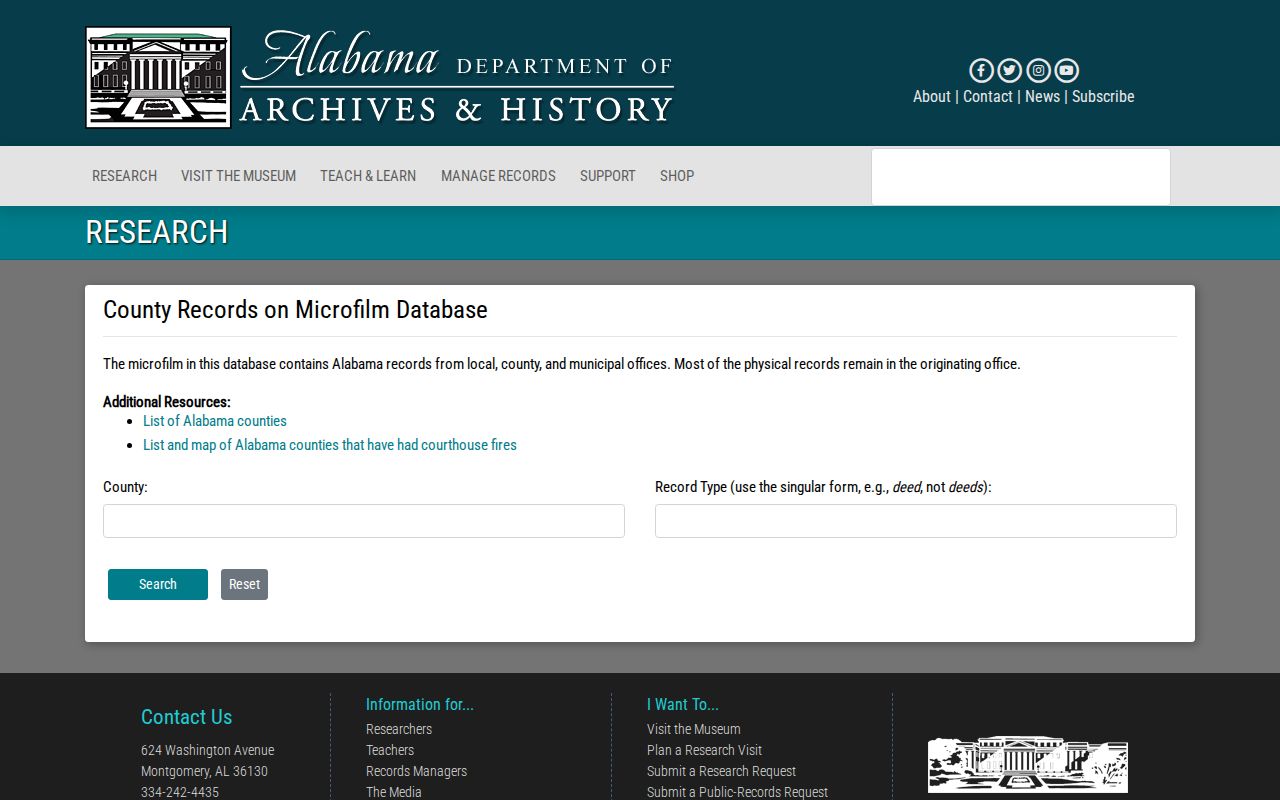
The image is a finding tool, not a scan of the city directory pages. ADAH is open Tuesday through Saturday from 8:30 a.m. to 4:30 p.m., with the last pull at 4. Limited research is listed at $15 for an Alabama resident and $25 for a nonresident, plus charges after 25 pages.
Shelby County Library Records Routes
Public Libraries of Shelby County has 14 catalog participants. Its database gateway includes HeritageQuest, which covers federal censuses, genealogy and local-history books, Freedman’s Bank records, PERSI, Revolutionary War material, and the U.S. Serial Set. Remote use follows the library network's local database rules.
No official branch page confirmed a special directory shelf, obituary index, reverse-directory run, or house-history service. Ask a branch to check the shared catalog before traveling. The Library of Congress telephone-directory collection supplies another online lead, but the possible August 1980 Greater Shelby item still needs its exact item page, publisher, and address-order section verified.
Read Shelby County Directory Evidence
No page image from the verified 2000–2002 volumes was available during research. It would be inaccurate to claim that those books show a spouse, occupation, ownership mark, occupancy mark, or widow notation. Treat the first visit as an inspection as well as a name search.
| Title page | Record the exact title, publisher, edition, and stated coverage. |
|---|---|
| Name entry | Transcribe every word, initial, symbol, and address exactly as printed. |
| Abbreviation key | Use the volume's own key before expanding any shortened term. |
| Street section | Confirm that one exists before calling the volume address-keyed or reverse. |
| Front matter | Check geographic scope and statements about omitted or unlisted entries. |
A name match is a lead. Parcel, deed, marriage, probate, census, and newspaper evidence can separate people who share the same name.
- Criss-cross directory
- A directory arranged by street address rather than only by surname. Its presence must be checked in each volume.
- Householder index
- A list centered on named household heads. It does not establish every person who lived at an address.
- Abbreviation key
- The publisher's own guide to shortened words and marks. Meanings can differ by edition.
Shelby County Archive Directory Indexes
The Shelby County Museum & Archives research gateway reaches far beyond the short printed-directory run. Its online index titles cover marriages, estates, county books, cemeteries, wills, surnames, loose court files, obituaries, divorces, oral histories, and the Datcher Collection. The index can identify a promising record group, while the original item remains at the Old Courthouse.
Take surname variants, initials, a date range, and a place range. The patron library holds books, periodicals, microfilm, microfiche, and family folders. Bolton Funeral Home material from 1957 through 1994 can close a family trail when a person drops from a directory. The archive is at 1854 Old Courthouse Circle and is open Tuesday through Friday, 9 a.m. to 3 p.m.; the phone is 205-669-3912.
Note: The newspaper span begins in 1866, but that holdings range does not promise that every issue or date survives.
Shelby County Directories Between Censuses
School censuses give Shelby County family historians a local bridge. The 1912, 1916, 1920, and 1924 rolls can state guardian, student, age, and race. Detailed cards may add a mailing address and occupation. Federal census records are public through 1950, while Alabama censuses for 1850, 1855, and 1866 add household evidence between federal schedules.
Use the closest dated source on both sides of a directory clue. A directory absence does not prove a move. Death, marriage, divorce, a missed issue, an unlisted number, or rural coverage can cause the same gap. Search county newspapers with initials, spouse names, community names, and property terms before drawing a conclusion.
- Transcribe the Shelby County city directory entry and its key.
- Check adjacent available years without assuming continuous publication.
- Pair the clue with the nearest census or school-census year.
- Test the address or identity through land, marriage, probate, and newspaper records.
- Mark each conclusion as confirmed, likely, or unresolved.
Montevallo Directories Reconnect Shelby County
Montevallo has an unusually useful institutional layer. The University of Montevallo Anna Crawford Milner Archives holds yearbooks, alumni information, and College Night spirit books. Its cited coverage includes yearbooks from 1907 onward, the Alabamian from 1924, newspaper scrapbooks from 1915 through 1995, and catalogs and pamphlets from 1895 onward.
The Montevallo Historical Society online archives link university and Alabama College yearbooks, the student paper, catalogs, W.M. Wyatt newspapers, Montevallo High Montala yearbooks, Spotlight, and the Ralph & Marcia Sears Digital Media Archive released in June 2024.
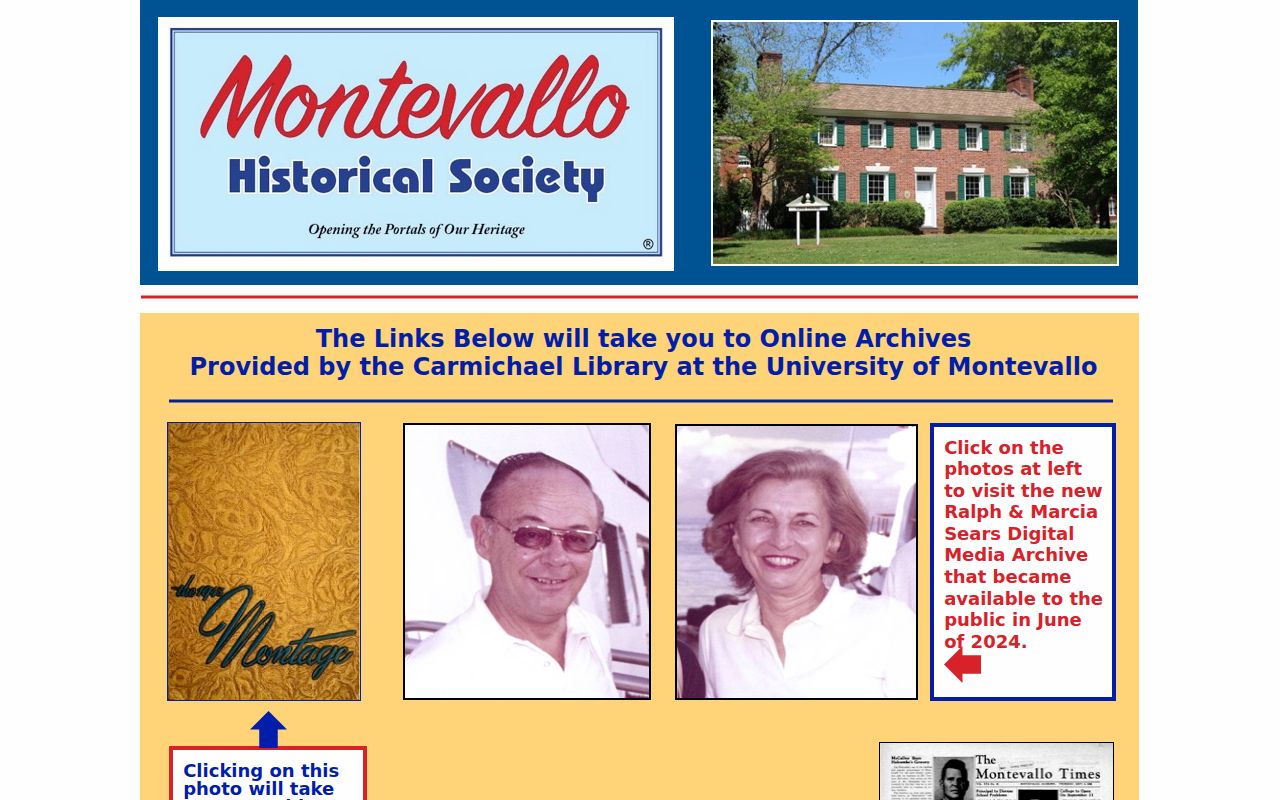
These records can reconnect a former classmate to a school year or campus role. They do not prove a permanent county address, so pair the clue with a household or land record.
Shelby County Directory Meets Sanborn
Sanborn fire-insurance maps place buildings and streets in time. Verified Library of Congress runs cover Calera in 1889, 1897, 1903, 1909, and 1923; Columbiana in 1909 and 1923; Montevallo in 1933; and Shelby in 1905, 1910, and 1923. Calera has the longest confirmed local run.
A map can show a structure footprint, street pattern, or use. It does not name an occupant. Match the mapped site to a census, deed, school census, newspaper, or inspected directory entry. An address missing from a sheet may sit beyond the map limits, so absence alone does not show that no building stood there.
For current address-keyed work, use the Shelby County Street Directory rather than treating an old map as a present resident roll.
Datcher Indexes Shelby County Residents
The Datcher Collection begins in 1818 and references more than 3,500 enslaved people. That scale matters because conventional property-era systems often obscured names or recorded people as property. The collection offers a name-bearing route into records that otherwise flatten family identity.
Use the Datcher index with deeds, estates, wills, 1850 and 1860 slave schedules, the 1867 registration books, and church or cemetery evidence. Surname continuity may begin after emancipation. Search broadly by place and associated people, not just by a later surname.
Shelby County Directory History Survived
Shelby County was created in 1818. The seat moved from Shelbyville to Columbia in 1826, and Columbia became Columbiana in 1832. Those names belong in catalog searches because the same county story may be filed under different place terms.
| Year | Research milestone |
|---|---|
| 1818 | Shelby County was created. |
| 1820 | The county dates its first “authentic records” to this year. |
| 1826 | The county seat moved to Columbia. |
| 1832 | Columbia was renamed Columbiana. |
| 1854 | The courthouse now used by the Museum & Archives was built. |
| 1982 | The restored courthouse opened as the Museum & Archives. |
The 1854 courthouse narrowly escaped demolition. Its survival explains why the historical reference desk and the active courthouse offices are now separate destinations. No sweeping courthouse-fire loss was verified for Shelby County.
Trace Shelby County Directory Households
Begin with the firmest known name, date, and community. Search Siluria, Maylene, Saginaw, Dunnavant, Wilson’s Hill, and other historic place terms alongside modern postal names. Rural routes and old locality labels can describe the same land long before a modern street address existed.
Printed directories omit unlisted people, many household members, and some rural addresses. Telephone directories are not automatically city directories, and neither form is automatically criss-cross. Preserve the wording of every source and do not turn a clue into a claim it cannot support.
When a historical identity needs a modern cross-check, the Shelby County resident lookup separates current public indexes from archive evidence. Keep living-person research lawful, personal, and respectful.